


Key Insights into Melbourne’s Short-term rental Market
As Melbourne’s holiday home market enters the latter half of the year, it’s an ideal moment to evaluate the performance during the busy summer months and the subsequent shoulder season (December to May).
This overview aims to offer valuable insights and data on the vacation rental market for Airbnb hosts, property managers, and anyone in Australia interested in the dynamics of short-term rentals. Let’s delve into the trends, guest behaviors, and market performance observed during this time.
Melbourne Market Data & Trends
The summer and following shoulder season in Melbourne showcased a compelling array of trends. Although reduced average daily rates (ADRs) contributed to higher occupancy rates, they fell short of generating a year-over-year increase in Revenue Per Available Night (RevPAN). Nonetheless, it’s important to highlight that the RevPAN was only slightly behind that of the previous year.
Occupancy Rates
This year, occupancy rates experienced a slight increase. Although this rise may seem minor, it reflects a consistent demand for holiday homes in Melbourne despite varying market conditions.
- Dec. 2022-May 2023: 65.4%
- Dec. 2023-May 2024: 65.8%
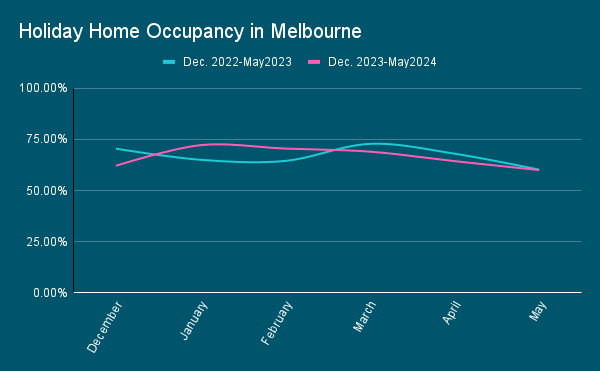
Source: Beyond
Average Daily Rates (ADR)
Despite the increase in occupancy rates, average daily rates (ADRs) experienced a significant decline. This drop suggests that property managers and hosts modified their pricing strategies to stay competitive and attract more bookings, which contributed to the year-over-year growth in occupancy rates.
- Dec. 2022-May 2023: $269
- Dec. 2023-May 2024: $233
Revenue Per Available Night (RevPAN)
Even with higher occupancy, the falling ADRs negatively affected the Revenue Per Available Night (RevPAN) for property managers and hosts.
- Dec. 2022-May 2023: $174
- Dec. 2023-May 2024: $160
The Eras Tour Effect
When Taylor Swift’s Eras Tour made its highly anticipated stop in Melbourne, it triggered a remarkable surge in the city’s holiday rental market. Fans, eager to experience their favorite songs live, flocked to the city, driving the average occupancy rate to an impressive 86%.
This spike in demand also led to an increase in the average daily rate (ADR), which rose to $406, as hosts recognized that fans were willing to pay a premium. This excitement resulted in a notable Revenue Per Available Night (RevPAN) of $348, demonstrating the holiday home market’s resilience in the face of overwhelming popularity.
Guest Insights
Understanding guest behavior is essential for optimizing rental performance, so we analyzed year-over-year metrics to provide a clearer picture of current trends. Here’s a snapshot of key guest metrics:
Average Length of Stay
The average length of stay has seen a slight increase:
- Previous Year: 4.8 nights
- Two Years Ago: 4.4 nights
This trend indicates that guests are opting for longer stays, potentially reflecting changing travel patterns and preferences.
Median Booking Lead Time
The median booking lead time has experienced a minor decrease:
- Previous Year: 20.7 days
- Two Years Ago: 21.2 days
While this change is subtle, it suggests a slight shift towards more last-minute bookings, likely influenced by evolving guest behaviors, such as spontaneous travel plans.
Preferred Booking Channel
Airbnb remains the leading booking platform for holiday homes in Melbourne. Its user-friendly interface, extensive reach, and trusted reputation make it the preferred choice for both hosts and guests.
Leveraging Technology for Enhanced Performance
To maintain a competitive advantage, savvy hosts are embracing technology. By utilizing tools such as Airbnb pricing software, holiday home management systems, and comprehensive vacation rental market data, hosts can gain actionable insights and automate various aspects of property management.
Tips for Airbnb Hosts, Property Managers, and Revenue Managers
As we approach the latter half of the year, many Australian hosts and property managers are seizing the opportunity to refine their rental strategies. Remember to incorporate your revenue management approach into this process!
Here are some key tips to optimize performance during the low season:
- Flexible Pricing: Use dynamic pricing tools to adjust your rates based on real-time demand and competition. This will help you remain competitive and attract more bookings even during slower periods.
- Understand Your Market: Knowledge of your market is crucial. Research local trends, customer preferences, and upcoming events that could influence demand.
- Monitor Your Competitors: Stay informed about your competitors’ activities. Keep track of their pricing, promotions, and reviews to ensure your offerings remain appealing and competitive.
- Adopt Forward-Thinking Strategies: Relying solely on historical data is no longer sufficient for effective revenue management. As shown this summer, anticipating trends and proactively adjusting your strategies is essential to avoid missed bookings and lost revenue.
Melbourne’s holiday home market has demonstrated resilience and adaptability throughout the summer and shoulder season. While declining ADRs have affected RevPAN, steady occupancy rates and an increase in the average length of stay highlight a strong demand for short term rental or vacational homes.
For Airbnb hosts and property managers, these insights can help refine pricing strategies, enhance guest experiences, and drive success in the competitive short-term rental landscape.
By incorporating these insights and utilizing the latest short term rental management software, you can ensure your property remains a top choice for travellers.
Want to discover the impact Fond Homes can have on your property? Let’s chat!
All monetary values are presented in AUD. Data Source: Beyond
Let’s discuss